
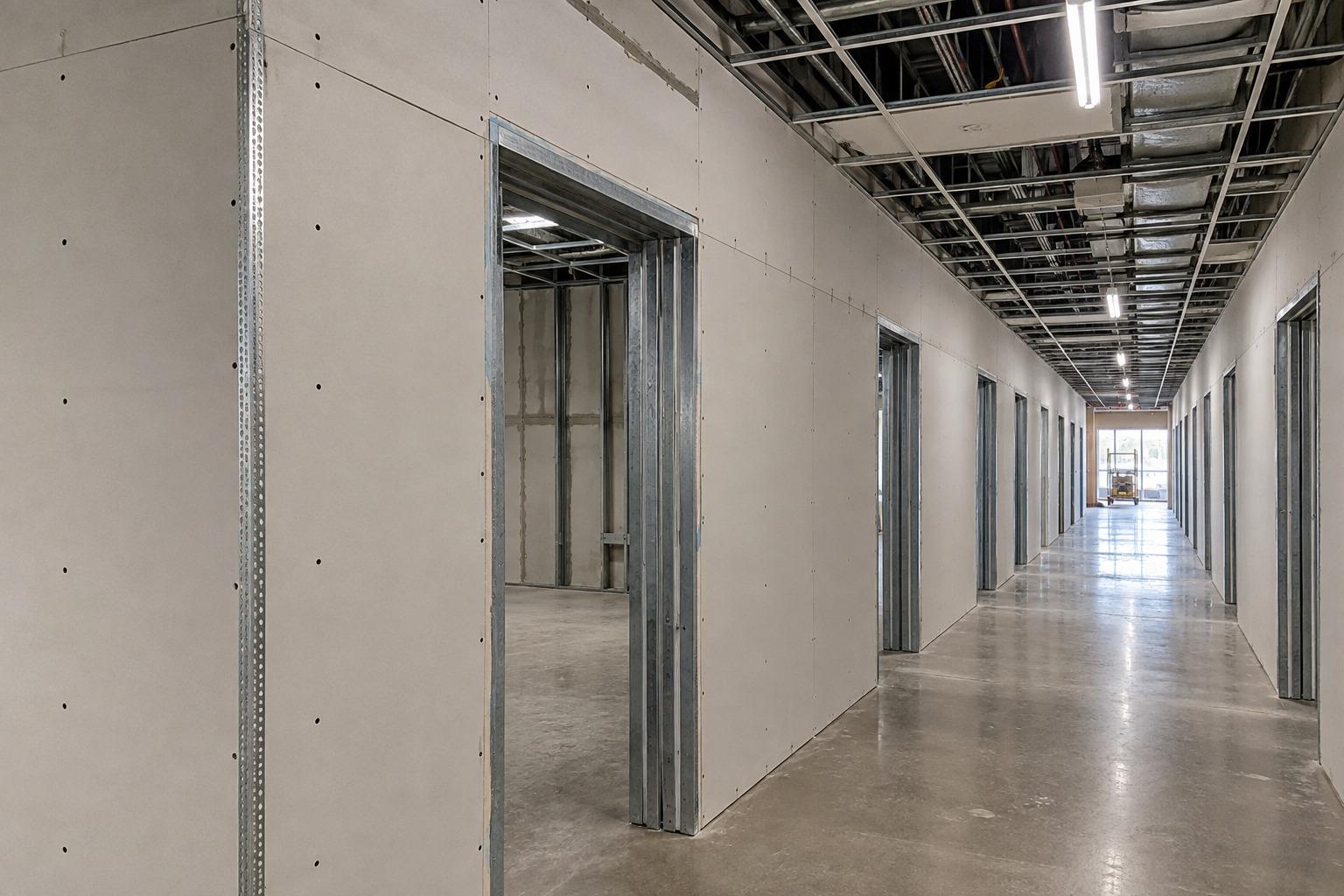
Impact Resistant Drywall Installation in Los Angeles, CA
Abuse resistant drywall is engineered to survive the wall damage a building generates on its own: carts scraping a corridor, backpacks dragging a hallway, furniture landing against a lobby wall, and the occasional foot going through a stairwell. Panels are classified under ASTM C1629, which grades four separate durability properties on a three level scale, so a specification can demand the right kind of toughness instead of a thicker sheet. Los Angeles Drywall & Framing installs these systems for schools, healthcare facilities, hotels, and apartment common areas across LA County, where the maintenance budget pays for the wrong choice.
Spec a Durable Wall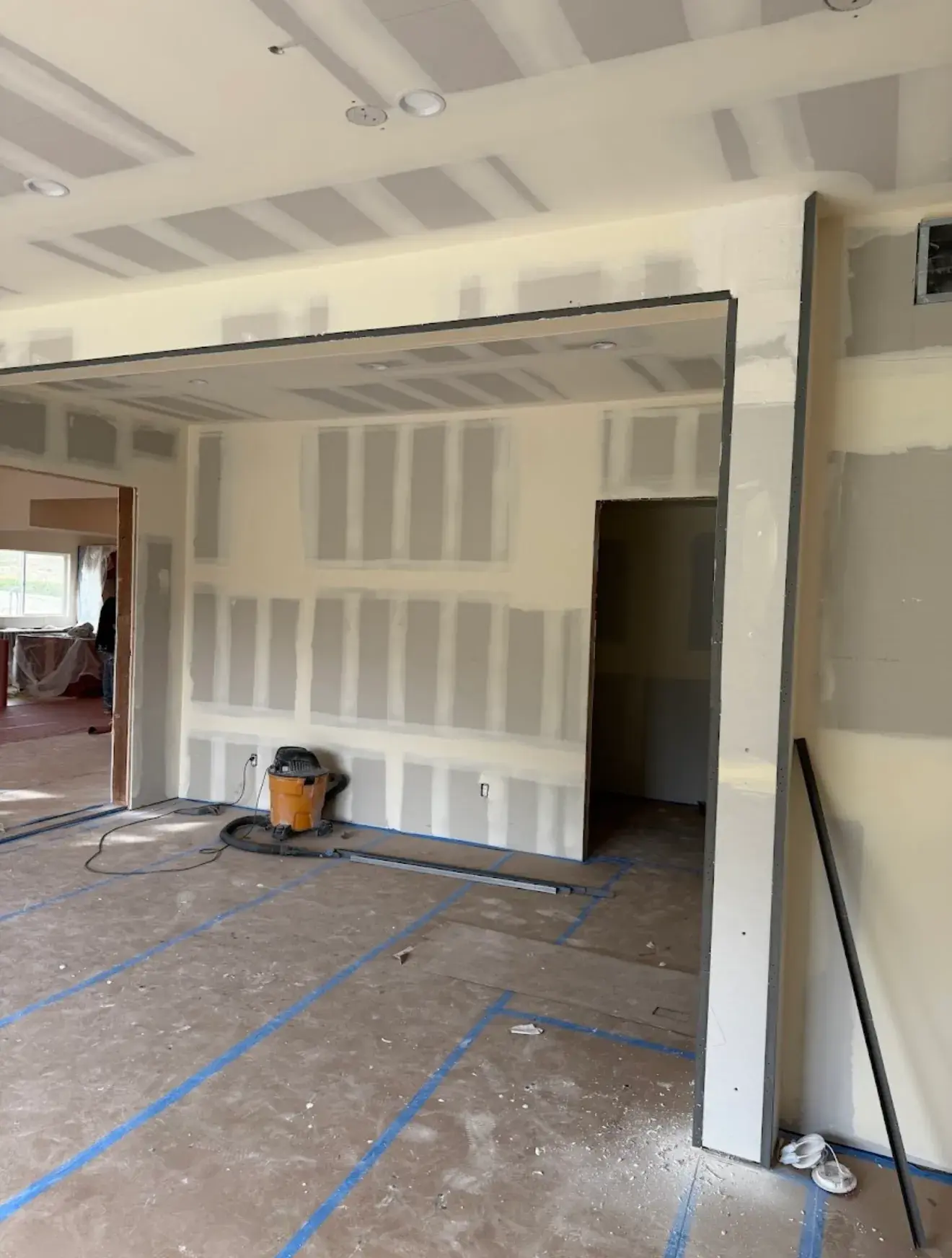
High Traffic Wall Systems
Los Angeles, CA
Four Different Failures, Four Different Tests, Three Levels Each
Walls do not fail in one way, so ASTM C1629 does not measure them in one way. Surface abrasion under ASTM D4977 scores how the face holds up to repeated rubbing, the damage a rolling cart or a shoulder produces over years. Indentation under ASTM D5420 drops a 5/8 inch hemispherical head at 72 inch pounds and measures the dent. Soft body impact reproduces a body or a bag hitting the wall and requires at least 90 foot pounds to qualify. Hard body impact swings a weighted ram and requires at least 50 foot pounds, with the top classification at 150. Each property carries its own level from 1 to 3.
In California the buildings that need this the most are also the buildings under the tightest review. K through 12 schools and community colleges fall under the Division of the State Architect, which has overseen design and construction of California public school buildings under the Field Act since 1933. Hospitals, skilled nursing facilities, and licensed clinics are reviewed and inspected by the Department of Health Care Access and Information, the agency that absorbed OSHPD. On those projects a submitted panel has to carry documented C1629 classification levels, and swapping in a lookalike product after approval is not a field decision. We supply the classification data with the submittal and install what was approved.
The other half of the job is the wall behind the panel. A Level 3 hard body panel screwed to 25 gauge studs at 24 inches on center will still dent, because the framing flexes and the board follows it. On abuse rated scopes we look at stud gauge, stud spacing, blocking behind handrails and corner guards, and whether the base of the wall needs solid backing. A durable corridor in a Downtown LA hotel or a Valley school is a framing decision and a board decision made together, and specifying one without the other is how owners pay a premium for panels that still show every cart strike.
Surface Damage and Penetration Are Two Separate Problems
Abuse Resistant Panels
Abuse resistant board targets the face of the wall. A denser core and a tougher facing raise the surface abrasion and indentation numbers, so scuffs, gouges, and dents from ordinary daily contact stop accumulating. This is the right product for a school corridor where backpacks graze the wall every passing period, for hotel hallways where luggage carts track the same line, and for apartment common areas where furniture moves in and out on every turn. It resists wear extremely well, and it is not designed to stop something going through.
Impact Resistant Panels
Impact resistant board targets penetration. These panels add reinforcement, commonly a fiberglass mesh or a heavy backing layer laminated to the panel, so a hard blow from a cart corner, a tool, or a boot heel does not open a hole through to the cavity. They carry the higher hard body classifications under C1629 Annex A1. Loading docks, gymnasium walls, back of house corridors, detention and behavioral health areas, and stairwells in high turnover buildings are the places where this level of protection clearly earns its cost over the life of the building.
Rated and Durable in One Wall
Most corridors that need durability also need an hourly rating, and the two requirements are met by the same sheet when the panel is manufactured with a Type X core and listed in the appropriate assembly. We confirm the specific product appears in the referenced design before ordering, because a durability upgrade that is not part of the tested assembly is not an upgrade the inspector will accept. Where no listing covers the combination, we build the rating and the durability as separate layers within the same wall so both requirements are satisfied independently.
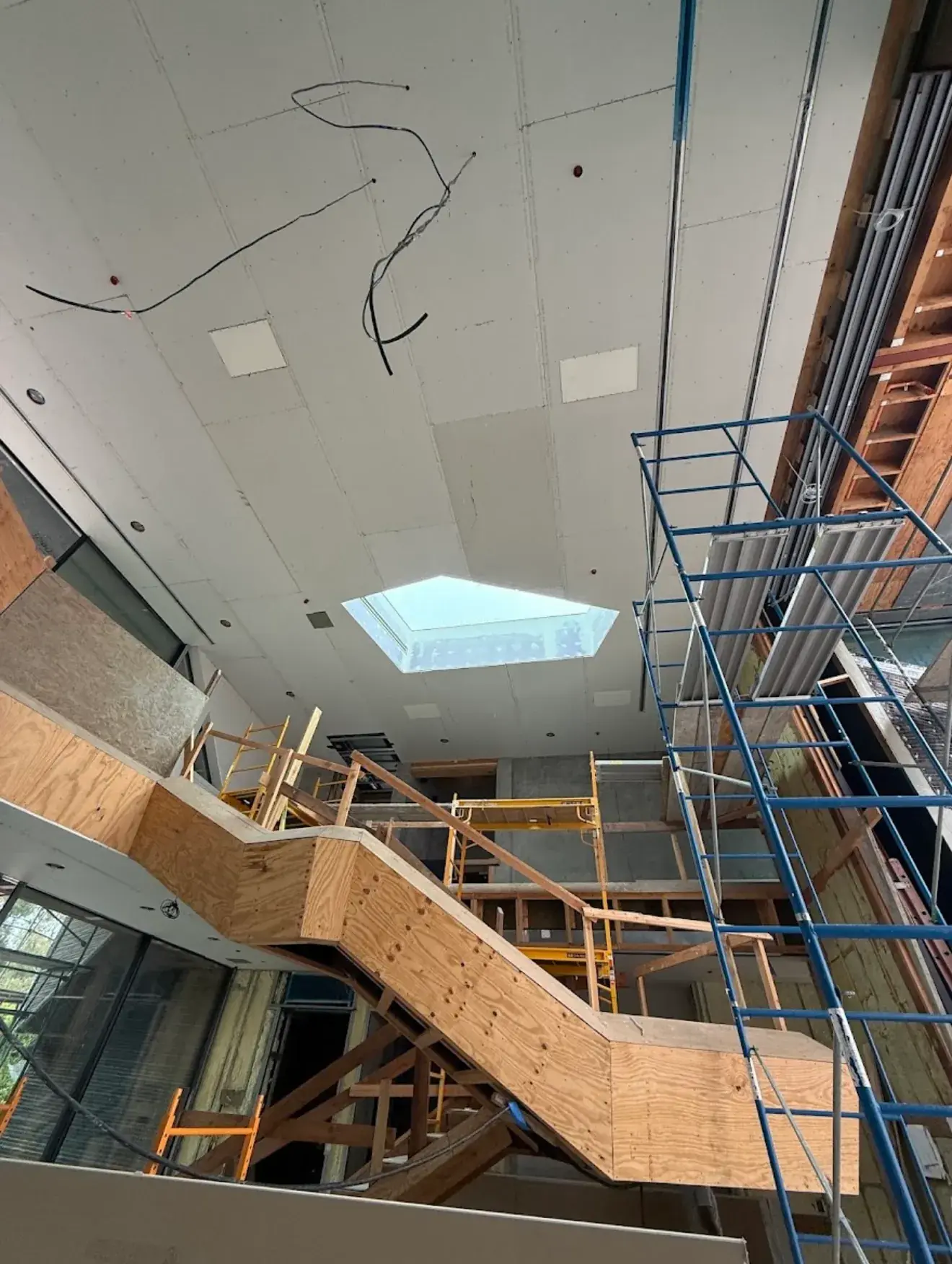
Classification Data With the Submittal
Every abuse rated panel we propose arrives with its published C1629 levels for all four properties rather than a single headline number. That matters because a product can be strong in indentation and entirely unremarkable in hard body impact. Architects reviewing the submittal see the full performance profile, and the owner knows precisely which failure mode the finished wall is protected against and which one it is not, before a purchase order is written.
Framing Sized for the Abuse
Panel classification assumes the substrate behind it does its part. On durable wall scopes we tighten stud spacing, step up stud gauge wherever the specification allows it, and add continuous blocking behind rails, corner guards, bumper strips, and wall mounted equipment. A stiff wall keeps the panel from deflecting into its own failure point when something heavy arrives at speed, which is the moment the whole specification is being tested.
Reading an ASTM C1629 Classification
Four properties, three levels each, and a minimum threshold that a panel has to clear before it can claim anything at all.
- ASTM C1629
- The classification standard for abuse resistant nondecorated interior gypsum panels and fiber reinforced cement panels. It assigns Level 1 through Level 3 for each property, Level 1 being the lowest.
- Surface Abrasion
- Measured by ASTM D4977 with a weighted scrub action against the panel face. Level 1 allows an abraded depth up to 0.126 inch; higher levels tighten that limit considerably.
- Indentation
- ASTM D5420 drops a 5/8 inch hemispherical head at 72 inch pounds. Level 2 permits a maximum of 0.059 inch, and any panel indenting past 0.150 inch cannot be classified at all.
- Soft Body Impact
- A leather bag loaded with steel shot is swung into the assembly. A panel must withstand at least 90 foot pounds to classify, representing a person or a loaded bag rather than a sharp object.
- Hard Body Impact
- Annex A1 uses a weighted ram delivering progressively heavier blows. A minimum of 50 foot pounds is required to classify as impact resistant, and Level 3 requires 150 foot pounds before penetration.
- Where Levels Belong
- School and hotel circulation is usually specified for high abrasion and indentation with moderate impact. Healthcare corridors, kitchens, and loading routes take cart strikes, so they call for the upper hard body levels instead.
- Substrate Requirements
- Classification is established on a tested assembly. Stud gauge, stud spacing, and fastener pattern all influence field performance, so panel selection and framing specification are made together rather than in sequence.
How We Deliver Durable Wall Systems
Abuse rated work is specification driven. Our process is built around getting the right classification approved and then keeping it intact through construction.
Map the Damage
On existing buildings we walk the space with the facilities manager and look at what is actually breaking. Dents at cart height, abraded bands along a corridor, and punched holes at stairwell landings each point to a different property. On new construction we work from the program instead, asking what equipment moves through each area and how often, which produces a targeted specification rather than a blanket upgrade.
Select Levels by Zone
We assign classification levels area by area. A lobby may need surface durability and nothing more, while a service corridor behind it needs the top hard body level. Specifying the highest available panel everywhere wastes budget that belongs in the two or three zones that genuinely take punishment. The zoning is documented so that the estimate, the submittal, and the field installation all agree with one another.
Submit and Approve
Product data with the full four property classification goes into the submittal package, along with the fire resistance listing where the wall is also rated. On school and healthcare work in California this package goes through state level review, so we prepare it early and we do not substitute after approval. Any value engineering proposal gets evaluated against the classification levels before it is priced.
Frame for the Load
Framing goes in with the spacing and gauge the durable wall requires, and blocking is installed behind every rail, guard, bumper, and mounted fixture that will transfer force into the wall. Corners in traffic paths get reinforced. We coordinate the blocking layout with the millwork, equipment, and signage packages so nothing is mounted later into an unbacked cavity.
Hang, Reinforce, Protect
Panels are hung with the fastener pattern the manufacturer specifies for the abuse rated product, which is often tighter than standard board. Corners get metal reinforcement rather than paper bead. After finish, we install or coordinate the corner guards and impact rails the design calls for, because unprotected outside corners fail long before the field of a Level 3 panel does.
Services That Pair With Impact Resistant Drywall Installation
Durable walls depend on the framing and the rated assembly around them. These services usually share the scope on a high traffic project.
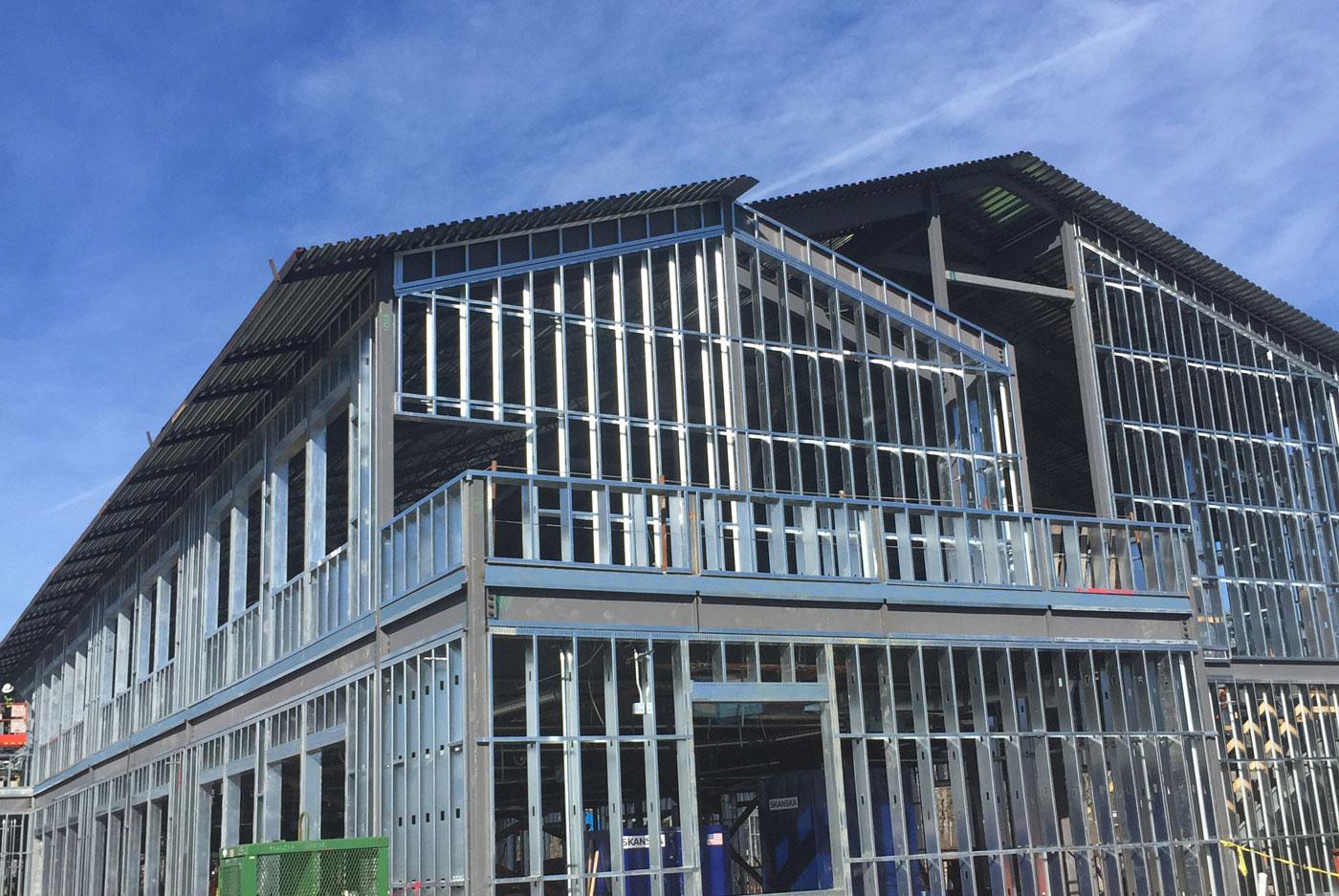
Commercial Metal Stud Framing
Full-building metal stud framing for commercial shells and tenant improvements: partitions, shaft walls, rated corridors, and exterior backup framing on schedule.
Multi-Family Drywall
Production drywall for apartments, condos, and podium projects. Rated demising walls, shaft walls, and corridor assemblies hung and finished unit by unit.
Fire Rated Drywall Installation
Type X and Type C fire rated drywall installed to the exact UL listed assembly. One, two, and three hour rated walls, shafts, and ceilings for LA commercial and multi-family projects.

Drywall Installation
Complete drywall installation for new construction and renovation projects. Board hanging, fastening, and preparation for residential and commercial spaces across Los Angeles.
Where We Provide Impact Resistant Drywall Installation
We install abuse and impact resistant gypsum panels for schools, healthcare, hospitality, and multi family buildings throughout the Los Angeles region.
Central Los Angeles
Westside & Beach Cities
San Fernando Valley
South Bay & Long Beach
Orange County
Abuse Resistant Drywall Questions
What is the difference between abuse resistant and impact resistant drywall?
Is impact resistant drywall better than two layers of standard drywall?
What C1629 level should I specify for a school corridor?
Can abuse resistant drywall also be fire rated?
Does impact resistant drywall cost more to install in Los Angeles?
Can you install abuse resistant board in an occupied building?
Request a Free
Estimate
We are ready to bring your project to life. Reach out for a free estimate on your drywall, framing, or specialty project. Our team responds within 24 hours.